
Enough about me. Or maybe not. Exploring the worlds of The Asker and The Non-Asker.
Unpacking why some people probe and others proclaim, and the ways that different questions reveal different sorts of truth.

Maybe you’ve had the experience. Or its flip side.
You meet someone new. You ask them a few questions by way of getting to know them. They respond in a friendly manner, even enthusiastically. You pause for them to ask something about you.
Silence.
Or: You meet someone new. They hit you with one question after another. You do your best to respond, but they seem a bit intrusive.
You’re left a bit speechless.

By disposition and line of work, I fall into The Asker category. One of the biggest benefits of working as a journalist is the license to ask almost anything of almost anyone.
But I want to explore the dynamics of The Asker and The Non-Asker in less formal circumstances, settings that nevertheless can be important in nailing stuff down.
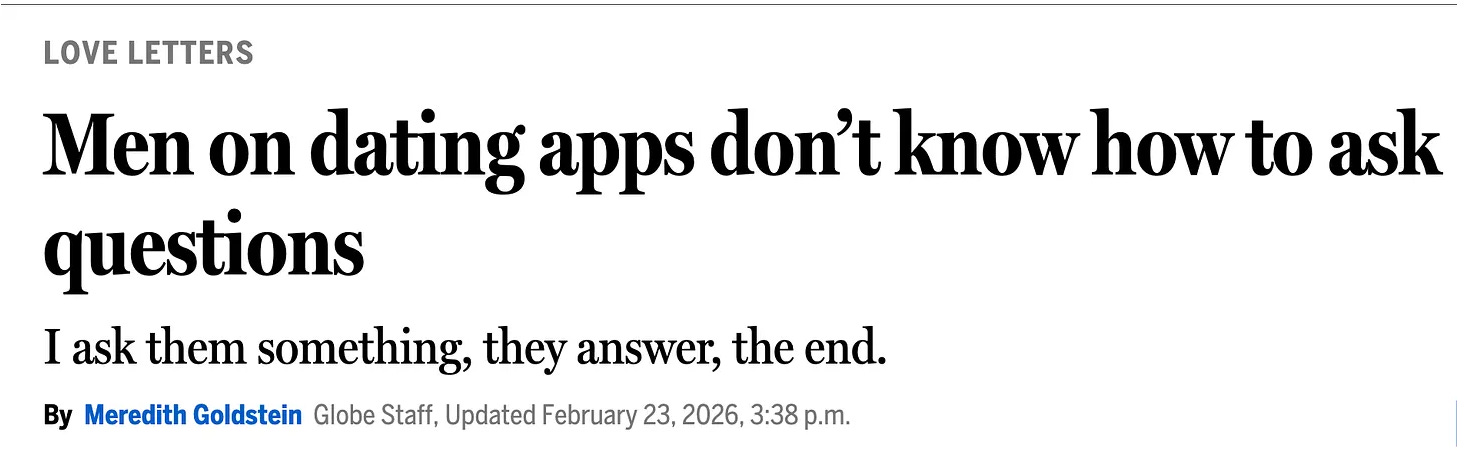
What got me thinking about this dynamic was a comment addressed the other day to Boston Globe advice columnist Meredith Goldstein:
…I have found that texting is a struggle because the majority of men don’t help carry a conversation. I will ask an open-ended question related to their profile. They will literally answer the question and zero follow-up. Not even a reciprocal “How about you?,” or “What do you think?”
The probers and the proclaimers
This is a recurring topic in advice columns, and it usually breaks down along gender lines: Women as Askers and men as Non-Askers who prefer to proclaim.
The linguist Deborah Tannen cautions against attributing the reticence of Non-Askers to a character flaw. Their silence, she suggests, is often a matter of respectful “high considerateness” or other factors. She attributes at least some of their lack of questions to a reluctance to intrude — perhaps putting themselves in the other’s shoes in ways that we Askers fail to do.
But Tannen also addresses the tendency of some Non-Askers to proclaim. She says the gender split often reveals a “rapport/report” dichotomy, with women seeing conversations as an opportunity for relationship building and men regarding them as a chance to deliver information or opinions.
Sarah Miller points out in The Guardian that “asking questions is not inherently virtuous.” The headline on her piece captures the frustration felt by “Askers” and suggests why it might be misplaced:

Research published in the Journal of Personality and Social Psychology digs deeper, pinpointing follow-up questions as key not only to more revealing conversations but to increased likelihood that the person answering the questions will like and appreciate the questioner. A bonus!
The authors note:
Follow-up questions are only possible if an individual asks an original question, listens to the answer, and probes for more information (i.e., understands the answer, validates the partner, and cares to know more—the definition of responsiveness).
All of which has me coming to terms with the likelihood that I’ve been romanticizing the world of Askers and pathologizing the less overtly inquisitive among us.
Acknowledging the limits of my curiosity
It’s also got me thinking about curiosity. As much as I consider myself a curious person, that curiosity has fallen short when it comes to Non-Askers. Instead, I fall back on assumptions: They’re self-absorbed, they’re not interested in me, etc. etc.
It shouldn’t have taken me this long. After all, I’ve been living for 55 years with someone whose approach to questions is dramatically different than mine.
As a clinical psychologist and subsequently a spiritual director, Carol approaches questions as a way of helping people learn more about themselves. In social settings, her questions seem aimed at making a connection with the person as opposed to learning something. I have to admit that my questions are more often aimed at eliciting information that I believe I’ll find interesting about the other person — or something they know that I don’t.
We both favor simple questions, an approach I discussed a few months ago in a newsletter headlined In praise of simple questions.
It pays to figure out the right questions before pursuing answers.
Like anything else, asking good questions benefits from practice. I’m especially fond of the “questions only” exercise devised by Pulitzer-winner and coach extraordinaire Jacqui Banaszynski. The idea, which I’ve used in newsrooms, workshops and my question-filled personal life: Agree with the people you’re with that for the next 15 minutes or so, everything uttered out loud will end with a question mark. It’s a great way to explore all corners of an issue. It pays to figure out the right questions before pursuing answers. You’ll find some specifics from Jacqui here.
It’s time for some new questions.
I also want to experiment with asking some different questions, hopefully framed with the kind of intentionality Carol practices.
The Wall Street Journal published a column by Rachel Feintzeig a few years ago with this piece of advice: “Stop Telling Everyone What You Do for a Living.”
Partly by way of encouraging people to ask me the same question, I admit to resorting to the “What do you do?” question as a cornerstone of my small talk.
Feintzeig interviewed a woman who did the same thing before switching to such questions as “What fills your time?” or “What gives you joy?”
I’m thinking more along the lines of “What are you up to these days?”
I’ll let you know how it goes.
In the comments below, I hope you’ll chime in: Are you an Asker or a Non-Asker? What are some of your go-to questions these days? What’s an especially ill-considered question you’ve been asked? An especially good one?
Delightful, Bill! (Non-asking for a friend...)
What a great entry for my mind's file box; of course, I am too old to make full use of advice on
answering that onerous question of employment. I would like to have Thomas Merton's moxie when asked that very question (yes someone did). I can't, with surety quote him, but I think it
included the word "breath". Marlene